Door-to-door canvassing remains the gold standard for voter contact in political campaigns. While digital ads and social media grab headlines, academic research consistently shows that personal conversations at the doorstep move votes in ways that screens simply cannot replicate. Whether you’re a first-time canvasser or a campaign manager building your field program, understanding the fundamentals will determine whether your efforts translate into wins on election day.
This guide breaks down everything you need to know about effective canvassing—from preparation and core behaviors to common mistakes and legal considerations. You’ll also see how tools like Pulsar can transform your canvassing campaign from clipboard chaos into a data-driven operation.
Key Takeaways
- Door-to-door canvassing consistently boosts voter turnout by 7-10% and can shift close races in 2026 when executed properly
- New political canvassers succeed by following simple do’s (prepare thoroughly, stay on script, listen actively) and don’ts (don’t argue, don’t break local laws, don’t canvass alone)
- Safety protocols are non-negotiable: campaigns should implement check-in procedures, set clear cut-off times (no doors after 8:30 PM), and maintain zero tolerance for harassment
- Using Pulsar’s canvassing tools—including preloaded voter files, walk lists, and a mobile canvassing app—makes knocking doors more efficient, safer, and fully data-driven
- Skills improve quickly with practice and good systems, making your first canvassing experience far less intimidating than you might expect
Why Door-to-Door Canvassing Still Wins Campaigns
Personal contact at the door has consistently boosted turnout by several percentage points across dozens of academic studies since the early 2000s. This isn’t nostalgia—it’s data. Research from the Obama era and subsequent campaigns demonstrates that face-to-face conversations at the doorstep yield 8-10% vote shifts among persuadable voters, compared to just 4-6% for phone canvassing.
Why does this approach people respond to so powerfully? When a volunteer shows up at someone’s home, it signals genuine investment. Voters can ask questions, voice concerns, and have a real conversation about local issues—schools, public safety, taxes—that matter to their daily lives. This exchange produces valuable information that campaign teams can’t get from social media metrics or TV advertising.
For first-time campaign managers, canvassing supports three core goals:
- Identifying supporters – Tagging voters by support level so you know who’s already with you
- Persuading undecided voters – Having conversations that move people toward your particular candidate
- Turning out supporters – Mobilizing identified backers in the final 72 hours before the election
Consider a city council race in 2023 where the margin of victory was just 127 votes. The winning campaign knocked over 3,000 doors in the final month, collecting contact details and following up with identified supporters via text and phone. Those few hundred meaningful conversations made the difference.
Pulsar powers modern field work by connecting voter data, walk lists, and canvasser notes in one political CRM. Instead of juggling spreadsheets and paper forms, your campaign team can see every voter interaction in real time.
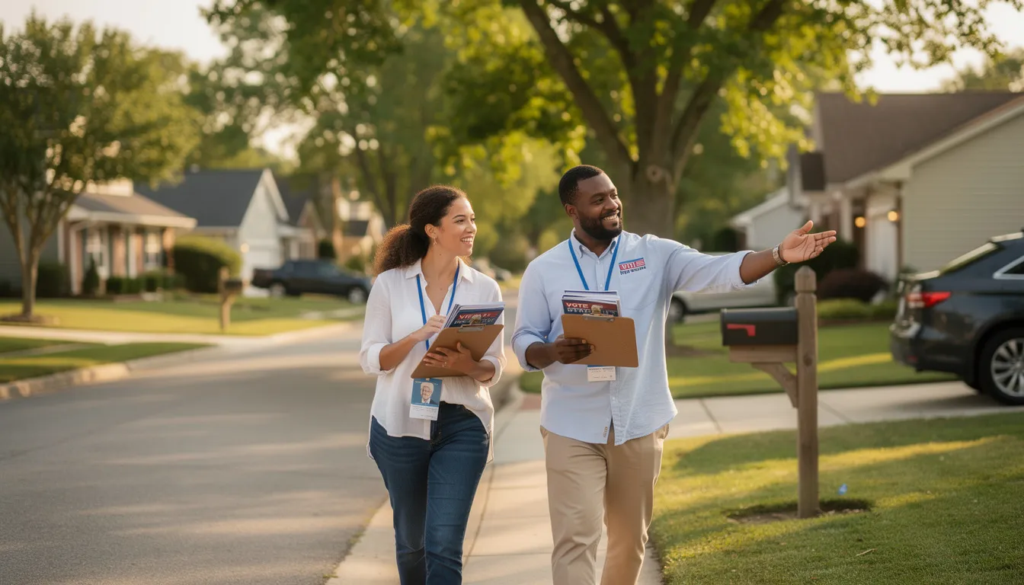
Getting Ready: Do’s Before You Ever Knock a Door
Preparation separates successful canvassing from wasted effort. Both canvassers and field organizers need to complete specific steps before the first door is knocked.
Training Is Essential
Campaigns should host a 30-60 minute training session before each major canvass. This covers:
- Script review and role-playing
- Goals for the shift (voter ID, persuasion, or GOTV)
- Safety protocols and buddy system
- How to use the canvassing app effectively
Scripts should be specific to your race. A 2024 state house canvass script will differ from a 2025 mayoral persuasion script. As election day approaches, the messaging shifts from identification to pure get-out-the-vote urgency.
Have volunteers rehearse the script in pairs before they hit their first house. This prevents that robotic, reading-off-a-page delivery that turns voters off. The goal is to sound natural while hitting every key phrases and data collection point.
What Volunteers Should Bring
Item | Why It Matters |
Fully charged phone | Access to canvassing app and route ahead |
Portable battery pack | Extended periods in the field drain batteries |
Water bottle | Hydration during 3-4 hour shifts |
Comfortable walking shoes | You’ll walk 5-10 miles per canvass |
Weather-appropriate clothing | Season-specific layers or rain gear |
Campaign ID badge | Legitimacy and positive impression at the door |
Campaign managers should use Pulsar to pre-cut walk lists by turf and assign them to specific volunteers ahead of time. Push these lists to the mobile canvassing interface so everyone arrives prepared with their route already loaded.
Set clear expectations: for local races, plan for 20-25 doors per hour. Let volunteers know what turf completion looks like—if the list has 80 addresses, a full shift should contact or attempt the majority.
Core Political Canvassing Do’s (For First-Time Knockers)
These essential behaviors make conversations at the door productive and respectful. Master these, and you’ll quickly feel confident as you approach people in your assigned turf.
Do Introduce Yourself Clearly
Start every interaction with your name, the campaign, and the office sought:
“Hi, I’m [Name], and I’m volunteering with [Candidate] for [Office]. Is [Voter Name] available?”
Confirming the voter’s name from your list immediately establishes that this is a targeted, professional outreach—not random door-to-door solicitation.
Do Follow the Script But Sound Natural
Your campaign provides talking points for a reason. Hit every question and data point, but speak in your own voice. The script is a framework, not a performance piece. When you encounter people who respond well, you’ll find common ground faster if you’re genuine rather than mechanical.
Do Listen More Than You Talk
The best canvassers ask open-ended questions and give voters space to describe their concerns:
- “What issues matter most to you this election?”
- “How do you feel about [local issue]?”
- “Is there anything you’d want [Candidate] to know?”
You’ll collect feedback that helps the campaign understand voter priorities. This also builds trust—people notice when you actually listen versus waiting for your turn to talk.
Do Capture Accurate Data
Mark support level, issue priorities, and follow up requests in the canvassing app right at the doorstep. Don’t rely on memory or scrap paper. Record different responses accurately:
- Strong support, lean support, undecided, lean oppose, strong oppose
- Specific issues mentioned
- Requests for yard signs, volunteer interest, or more information
With Pulsar, answers sync instantly back to HQ. Data from a Saturday canvass in October can update your persuasion universes by Monday morning, keeping your voter file up to date.
Do Respect Time
Keep most conversations under 3-5 minutes unless the person is clearly engaged. If your canvassing partner is advancing the turf while you’re still at one door, you’re probably staying too long. Brief, respectful interactions allow you to maximize coverage.
Do Leave Literature When Appropriate
When no one answers, leave a palm card or flyer with:
- Early voting dates
- Polling location information
- The campaign’s website and contact details
Studies show campaign literature boosts name recognition by 20-30% in low-awareness races. Never leave anyone’s next door neighbor wondering who knocked.
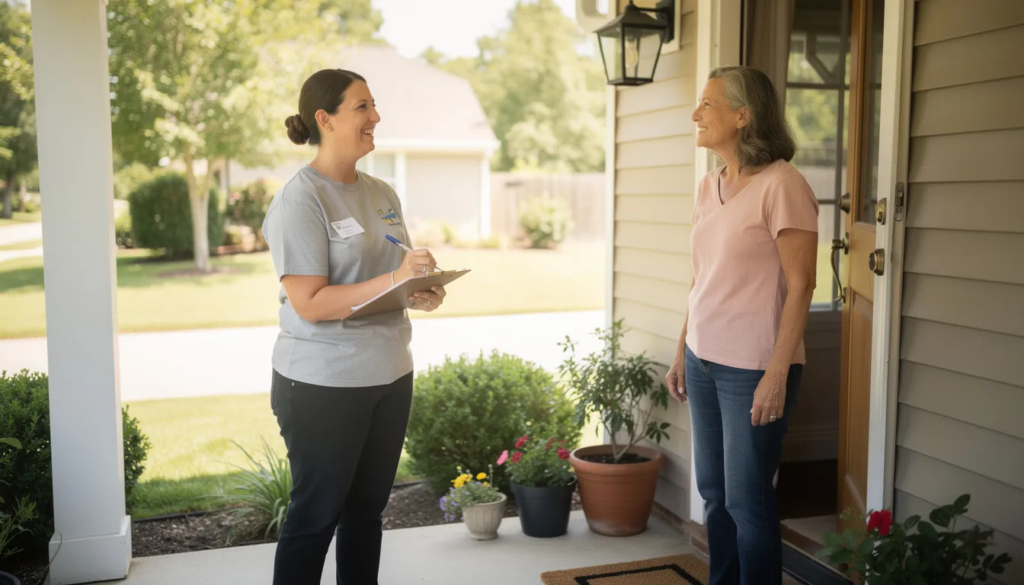
Canvassing Do’s for Organizers and Campaign Managers
This section is for field directors, campaign managers, and lead volunteers planning door-to-door operations at scale.
Do Define Your Goal for Each Canvass
Your canvassing strategy should evolve as the election approaches:
Timeframe | Primary Goal | Focus |
June-July | Voter ID | Identify potential supporters and opponents |
August-September | Persuasion | Move undecided voters with tailored messaging |
Final week before November 2026 | GOTV | Turn out identified supporters only |
Each shift should have a clear objective. Mixing goals confuses volunteers and muddies your data.
Do Target the Right Doors
Use modeled data and past turnout history to prioritize doors. Campaigns using data-driven turfs achieve 15-25% higher contact rates than random walks. Focus on:
- Likely supporters who need motivation to vote
- High-value swing households with persuadable voters
- Areas with strong turnout history in similar elections
Do Pair New Canvassers with Experienced Ones
Beginner-expert pairing for the first few shifts builds confidence and ensures quality control. New volunteer canvassers learn faster by watching someone handle different opinions and navigate common questions in real time.
Do Monitor Progress in Real Time
Use Pulsar dashboards to see doors knocked, contacts made, and support levels while the canvass is still in the field. This allows you to:
- Redirect volunteers from completed turfs to priority areas
- Identify canvassers who may need support
- Track whether you’re hitting your daily goals
Do Debrief After Every Shift
Spend 10-15 minutes gathering feedback:
- What common questions came up?
- Were there any safety issues?
- How did the script perform?
- Any data quality problems?
This information improves future canvassing activities and helps you refine your approach.
Do Maintain Clean Data
Correct bad addresses, mark moved or deceased voters, and remove hostile households from future walk lists. Poor data quality can inflate your persuadable voter counts by 10-15%, leading to wasted resources.
Pulsar’s political CRM stores each interaction so later phone banks, texts, and GOTV programs build on doorstep conversations instead of starting from zero.
Political Canvassing Don’ts: Mistakes That Cost You Votes
These common errors can undermine your entire field program. First-time canvassers and managers must actively avoid these pitfalls.
Don’t Argue with Voters
Once a conversation becomes heated, the best outcome is to exit politely, log the interaction, and move on. Arguments don’t persuade—they entrench opposition. If someone shares negative comments about your candidate, acknowledge their perspective and politely decline to engage further.
Confrontations drop volunteer retention by 30% and alienate neighbors through word-of-mouth. One bad interaction can poison an entire street.
Don’t Go Off Message or Freelance Policy Positions
Stick to your approved script and talking points. Unauthorized promises or comments can create real problems for the candidate. If you don’t know the answer to something, say so honestly and offer to have the campaign follow up via email or phone.
Don’t Ignore Body Language
Pay attention to signals:
- Voter stepping back or looking at a clock
- Arms crossed or door partially closed
- Holding a crying child or managing pets
If someone is clearly busy or uncomfortable, wrap up quickly and thank them. You won’t persuade someone who wants you gone.
Don’t Overstay
Aim for concise conversations. Twenty-minute debates prevent you from reaching the rest of your turf. Remember: you can always note a promising voter for phone follow up later.
Don’t Skip Data Entry
Never jot things down on scrap paper or try to remember support levels for later. Enter data immediately into Pulsar or your official canvass tool. Campaigns using paper methods lose approximately 25% of inputs, fragmenting your voter intelligence.
Don’t Mislead or Guess at Answers
If a canvasser doesn’t know specifics about a policy or local ordinance, they should say:
“That’s a great question. I don’t have the specific details, but I’ll make sure the campaign reaches out to you with that information.”
Then log the request for follow up.
Don’t Assign Giant, Unrealistic Walk Lists
Managers: giving new volunteers 200+ doors for their first shift leads to cut corners, fatigue, and incomplete data. Optimal for novices is 100-120 doors for a 4-6 hour shift, yielding 30-50 quality contacts.
Legal, Ethical, and Safety Do’s and Don’ts
Campaigns are responsible for keeping volunteers safe and compliant with local, state, and federal rules. These aren’t suggestions—they’re requirements.
Do Know Your Local Laws
Cities and counties often set quiet hours (no solicitation after 8-9 PM) and may have specific rules for multi-unit buildings. Research your jurisdiction before deploying canvassers. Ignoring local laws can result in complaints, fines, and negative press.
Don’t Put Literature in Mailboxes
In the United States, placing campaign literature in mailboxes violates federal postal law—technically a federal crime. Instead:
- Leave materials at the door
- Hang door hangers on the knob
- Place literature in screen door handles
Don’t Ignore “No Trespassing” or “No Soliciting” Signs
Skip those addresses and mark them in your canvassing system as do-not-knock. Campaigns that ignore these cues see 15% drops in subsequent door-open rates as word spreads about disrespectful canvassers.
Do Canvass in Pairs When Possible
Especially for evening shifts or less familiar neighborhoods. Paired teams report 40% fewer safety incidents than solo canvassers. Every canvassing partner should share their route ahead and estimated end time with a coordinator.
Do Set and Follow Safety Protocols
Essential elements include:
- Check-ins every 60-90 minutes via text
- Central meetup location at shift end
- Clear instructions to leave immediately if a situation feels unsafe
- Never canvass alone after dark
Don’t Enter Someone’s Home
Even if invited inside, canvassers should politely decline:
“Thank you so much, but I have many more doors to hit today. I appreciate the offer though!”
Entering homes creates liability risks and potential for false accusations. This rule protects both the volunteer and the campaign.
Don’t Invade Personal Space
Maintain appropriate physical distance at the door. Never make physical contact beyond a handshake if offered. Step back if the voter seems uncomfortable. Respecting personal space builds trust and leaves a positive impression.
Pulsar helps by mapping turf boundaries, flagging do-not-knock households in the voter file, and giving coordinators real-time visibility into which turf has active canvassers.
Using Pulsar to Plan, Run, and Track Your Canvassing
Modern door-to-door programs require modern tools. Here’s how Pulsar’s campaign platform supports every phase of your field operation.
Preloaded Voter Files
Pulsar includes preloaded voter files for many jurisdictions, allowing campaigns to build targeted canvassing lists without manually importing spreadsheets. This eliminates hours of data prep and ensures your lists are accurate from day one.
Smart Segmentation
Campaign staff can segment voters by:
- Support scores and prior ID results
- Turnout history and vote propensity
- Modeled issue preferences (healthcare, economy, education)
Assign each segment to specific canvasses—ID shifts for unknown voters, persuasion for undecideds, GOTV for identified supporters.
Mobile-First Canvassing Tools
Pulsar generates optimized turfs and pushes them directly to mobile devices. Volunteers can:
- View their walk list with voter details
- Log contacts, support levels, and notes at the doorstep
- Access the campaign script right in the app
- Work offline in areas with spotty coverage
Real-Time Data Sync
Every door knocked feeds immediately into Pulsar’s political CRM. This means:
- Phone banks can follow up with new supporters that same week
- Texting programs can reach volunteers identified in the field
- Campaign managers see accurate contact rates and progress
No more waiting for paper forms to be entered manually.
Example Scenario
A state legislative campaign in 2026 uses Pulsar to schedule a weekend canvass across 15 turfs. Field coordinators assign specific volunteers to each turf via the platform. As knocking begins Saturday morning, the dashboard shows real-time progress—doors attempted, contacts made, support levels logged.
By Sunday evening, the campaign manager knows exactly how many new supporters were identified and can report these numbers to the candidate. Monday morning, the data team builds a follow up phone list for the week ahead.
Ready to modernize your canvassing campaign? Schedule a Pulsar demo or request a quote to see how the platform scales your field program beyond clipboards and static spreadsheets.
Following These Canvassing Do’s and Don’ts in Your Next Field Program
Consistent training, clear scripts, and strict safety rules make door-to-door canvassing more effective and less stressful for first-timers. The skills you develop in your first few shifts—listening actively, capturing accurate data, maintaining respect—become second nature with practice.
The combination of good habits and avoided mistakes can swing close local races like school board or city council. When every canvasser on your team follows these canvassing tips, you build momentum that compounds throughout the campaign.
With tools like Pulsar, campaigns can treat every door knock as a data point that improves targeting and messaging across the entire race. Your canvassing activities become the foundation for phone banks, texting programs, and election day GOTV—all connected in one system.
To new canvassers and campaign managers: the first few doors feel awkward, but the awkwardness fades quickly. By your second shift, you’ll find yourself having natural conversations and building real connections with voters. That’s the power of door-to-door—and with the right systems supporting you, it’s also remarkably efficient.
FAQs about Canvassing Do’s and Don’ts
What should I actually say at the door on my first canvass?
Start with a simple, clear introduction: “Hi, my name is [Name], and I’m volunteering with [Candidate] for [Office] in the [Month Year] election.” Follow with one core message—maybe focusing on safer streets or better schools—then ask directly: “Can we count on your support?”
The exact wording comes from your campaign’s official script. Volunteers should stick closely to that script while keeping a natural tone. You’ll speak more confidently as you practice, and soon the words will flow without thinking.
Pulsar stores and displays scripts inside the canvassing tool, so volunteers always have the latest approved language on their phones—no need to memorize everything or carry paper scripts.
What should I wear for door-to-door canvassing?
Dress appropriately for the weather and plan to walk for hours. Light layers and walking shoes work well in September; a warm coat and gloves are essential for November canvasses. Avoid anything overly casual, controversial, or offensive.
Campaign-branded shirts, buttons, or lanyards help voters quickly recognize you as a legitimate representative. This professional appearance correlates with 10-15% higher door-open rates according to field studies.
Practicality matters: bring a hat, sunscreen, or rain jacket depending on your local climate. Some municipalities or campuses have specific rules about displaying campaign materials, so ask your organizer about any restrictions before you head out.
How long should I stay at each door, and when should I move on?
Most successful campaigns aim for 20-25 doors per hour, which means keeping interactions between 2-5 minutes. Wait about 20-30 seconds after knocking or ringing; if there’s no answer, leave literature (where legal) and mark the house as “Not Home” in your app.
If a voter is clearly uninterested or busy—checking their phone, glancing back inside, or giving short answers—thank them, record the outcome, and move on. Your goal is to maximize meaningful contacts across your turf, not to talk anyone into listening.
With Pulsar, organizers can use logged contact rates and average conversation lengths to refine future shift goals and staffing levels. If canvassers are averaging 15 doors per hour, the team knows something needs adjustment.
What should I do if someone becomes hostile or threatening at the door?
Never argue or escalate. If you encounter people who become aggressive, calmly end the conversation: “Thank you for your time. Have a good evening.” Then leave immediately. Don’t engage further or try to get the last word.
Any threats, harassment, or dangerous situations should be reported to 911 if there’s immediate danger. Once you’re safe, report the incident to your campaign field director or manager as soon as possible. The campaign should log that address in their system (like Pulsar) as do-not-knock and document the incident for future safety planning.
Campaigns should provide emotional support and debriefing for canvassers who experience hostility, especially first-time volunteers. One negative encounter shouldn’t end someone’s willingness to engage with voters.
How far from Election Day should we start canvassing?
Most local and state campaigns should begin structured door-to-door outreach several months before election day—for example, starting in late spring for a November general election. This gives you time to identify supporters, persuade undecideds, and build your volunteer base.
The focus evolves over time:
- Early months: Voter ID and volunteer recruitment
- Late summer/early fall: Persuasion targeting undecided voters
- Final 7-10 days: Pure GOTV targeting only identified supporters
Pulsar helps plan this timeline by letting campaigns tag contacts by canvass type and retarget them with subsequent phone calls, texts, and mail as the election approaches. Even smaller campaigns with limited resources should plan at least one strong ID pass and one GOTV pass through their highest-priority precincts.