Key Takeaways
Winning in 2024–2026 races depends on starting at least 12–18 months ahead with a clear vote goal and budget, not last-minute advertising.
A practical rule of thumb is 20% of time on strategy and 80% on disciplined execution (field work, fundraising, digital, and GOTV).
Data-driven voter targeting, authentic messaging, and relentless relationship-building are more decisive than ideology alone.
Modern campaigns must integrate field organizing, traditional media, and programmatic digital ads (social, CTV, search, etc.).
This article gives a step-by-step roadmap: from announcing a run, building a team and plan, to GOTV operations in the final two weeks.
Introduction: What “Winning” Really Means
In November 2024, a first-time congressional candidate in a suburban district spent 14 months building a volunteer army of 800 neighbors. She knocked on 47,000 doors personally. Her opponent outspent her 3-to-1 on television ads. She won by 1.5 percentage points—roughly 4,200 votes—because she understood something most campaigns miss: a political campaign is won through relationships, not billboards.
Winning a political campaign means different things depending on the race. For a city council candidate in 2025, it might mean securing 2,500 votes in a low-turnout municipal election. For a state legislative challenger in 2026, victory could require flipping 15,000 swing voters in competitive precincts. For a ballot initiative campaign, success means hitting 50%+1 across an entire state. But the fundamentals remain constant across every election cycle.
Victory is built on a foundation of clear objectives, realistic vote targets, message discipline, consistent voter outreach, and adequate resources. Most campaigns lose not because of bad luck or unfair opponents—they lose because they skip these steps and make excuses afterward. Winners follow through methodically.
This article is a practical playbook for candidates, campaign managers, and senior volunteers. It’s not a theoretical overview of politics or a history of successful campaigns. Instead, you’ll find step-by-step guidance from preparation before announcing, through defining your campaign strategy, building a professional operation, executing digital and media plans, running get out the vote operations, and handling post-election follow-through.
Set Your Strategic Foundation Early
Before you print a single yard sign or post your first social media announcement, you need a strategic foundation that will guide every decision for the next 12–18 months. This phase—often called the “planning period”—is where winning campaigns separate themselves from the pack.
Spend roughly 20% of your early campaign time (the first 2–3 months after deciding to run) on planning: district research, opponent analysis, and building your timeline. The remaining 80% should go toward disciplined execution once your campaign plan is locked. Campaigns that never stop “planning” often never start winning.
Calculate Your Vote Goal
Your vote goal is the single most important number in your entire campaign. It determines how many voters you need to reach, how much money you need to raise money for, and where your campaign team should focus its energy.
Here’s how to calculate it:
Find historical turnout. Look up how many people voted in the last comparable election. If you’re running for mayor in 2026, examine the 2022 mayoral race, not the 2024 presidential.
Project expected turnout. Adjust for trends. Midterm years typically see lower turnout than presidential years. Local elections often see 15–25% turnout compared to 50–65% in presidential years.
Calculate your win number. Multiply expected votes cast by 52% (50% to win, plus a 2% margin).
Add a safety margin. Increase by 3–7% depending on race volatility.
For example: If 60,000 voters participated in the 2022 mayoral race, expect similar turnout in 2026. Your basic win number is 31,200 (60,000 × 52%). With a 5% safety buffer, your vote goal becomes approximately 32,760.
This math must undergird every decision. If you can’t realistically reach your vote goal with your resources, you’re either in the wrong race or need to fundamentally change your approach.
Analyze Your Political Environment
Understanding your district goes far beyond partisan registration numbers. Dig into:
Demographics: Age distribution, racial composition, education levels, homeownership rates
Partisan lean: How did the district vote in recent presidential, gubernatorial, and local races?
Key issues: What local concerns dominate—housing affordability, public safety, climate change, school funding, infrastructure?
Turnout patterns: Which precincts vote consistently? Which surge only in presidential years?
Map Your Competition
Your opponent analysis should cover:
Factor | Questions to Answer |
Incumbency | Are they an incumbent with built-in advantages? |
Fundraising | How much did they raise last cycle? Who are their major donors? |
Name recognition | Have they been in politics for decades or are they new? |
Vulnerabilities | Unpopular votes, scandals, lack of local presence? |
Allies | Which organizations and elected officials endorse them? |
This research informs your messaging, resource allocation, and targeting decisions throughout the campaign cycle.
Choose Your Race Wisely
Not every candidate should run for every office. A successful political campaign strategy matches ambition with realistic assessment:
Network strength: Can you raise $50,000 in the first three months from personal contacts?
Name recognition: Have you been active in community meetings, local organizations, or issue advocacy?
Time commitment: Congressional campaigns require 40–60 hours weekly for 18+ months.
Sometimes the path to higher office runs through a winnable city council seat in 2025 rather than a long-shot congressional race in 2026.
Your foundational checklist:
Why are you running? (Clear, compelling answer in one sentence)
Who do you need to persuade? (Specific voter segments)
What margin must you achieve? (Calculated vote goal)
What resources do you have? (Time, money, volunteers, endorsements)
Define a Compelling Message and Brand
Voters in 2024–2026 are overwhelmed with information. They scroll past hundreds of posts daily, receive dozens of political mailers each cycle, and tune out most political debates. Your campaign message must cut through this noise with a sharp contrast expressed in a single, memorable sentence.
Most campaigns fail at messaging because they try to say everything to everyone. A winning campaign says one thing clearly and repeats it relentlessly until every voter can recite it.
Craft Your “Why You, Why Now” Statement
Your core campaign message must answer three questions:
What problem are you solving? (Specific, local, tangible)
Why are you the right person? (Experience, values, track record)
Why does this moment matter? (Urgency, contrast with opponent)
Strong example: “After 12 years of rising property taxes and declining school performance, Phoenix families deserve a council member who will freeze tax increases and redirect savings to classroom teachers—and as a 20-year resident and former school board volunteer, I’ll fight for that in my first budget.”
Weak example: “I believe in a better future for all of us and will bring people together to solve problems.”
The first message contains specific policy proposals, local grounding, and implicit contrast. The second says nothing memorable about this candidate versus any other candidates.
Build Your Personal Brand
Your brand weaves together:
Biography: Military service, business ownership, community organizing, teaching experience
Track record: Even small wins matter—leading a PTA, organizing a neighborhood cleanup, starting a local small-business coalition
Future plans with dates: What will you accomplish in your first 100 days? First budget cycle? First legislative session?

Test Your Message Before Scaling
Before spending thousands on paid media, test your message with:
Method | Purpose | Sample Size |
Small donor emails | Test which themes drive contributions | 500–2,000 recipients |
A/B Facebook/Instagram ads | Compare headlines and images | $200–500 spend |
Listening sessions | Refine language with undecided voters | 10–20 participants |
This testing phase can reveal that your housing message resonates more than your public safety message—or that talking points you assumed would work actually alienate likely voters.
Maintain Message Discipline
Every speech, mailer, door-knock script, and digital ad from filing date to election day should reinforce 2–3 core themes. Not a laundry list of policy papers. Not a different issue every week.
The discipline required here is harder than it sounds. Candidates get bored saying the same thing repeatedly. Reporters want to discuss national controversies. Opponents try to change the subject. Resist all of it.
Your campaign message isn’t for you—it’s for the voter who will hear it exactly once, 72 hours before casting a ballot.
Adapt by Race Type
Race Type | Messaging Considerations |
Nonpartisan municipal (2025) | Avoid partisan labels; focus on local service delivery |
Partisan primary | Emphasize differences from other candidates in your party |
General election | Draw contrast with opponent while appealing to persuadable independents |
Ballot initiatives | Single-issue clarity; yes/no framing |
Build a Professional Campaign Team and Structure
Winning campaigns are team sports. Even small-town races need defined roles, accountability, and communication rhythms. The candidate who tries to do everything personally will burn out and lose.
The size of your campaign team scales with the race, but the structure remains similar whether you’re running for school board or U.S. Senate.
Core Campaign Roles
Role | Responsibilities |
Campaign Manager | Overall strategy execution, candidate time management, staff coordination |
Finance Director | Donor research, call time management, event planning, compliance |
Field Director | Voter contact programs, volunteer recruitment, canvass operations |
Communications/Digital Lead | Message delivery, social media platforms, press relations, campaign website |
Data Director | Voter file management, targeting, tracking metrics |
Volunteer Coordinator | Recruitment, training, shift scheduling |
Treasurer | FEC/state compliance, financial reporting |
Legal Counsel | Election law, ballot access, voter protection |
When to Combine Roles
For a 2025 school board race with a $30,000 budget, your campaign manager likely handles communications, digital strategy, and volunteer coordination. You might have a part-time treasurer and rely heavily on campaign staffers who are actually volunteers.
For a competitive state legislative or congressional race, these roles must be separate. A single person cannot effectively run a voter file, manage 50 volunteers, and handle press inquiries.
Recruit Your Team
Draw from:
Local party committees and political parties with aligned values
Advocacy organizations in your issue space
Alumni networks from your school, profession, or military service
Unions and professional associations
Campaign alumni from 2020–2024 cycles who know your district
Establish Clear Decision-Making
Define early:
Who can approve mail pieces and digital ads?
Who sets weekly field goals?
Who has access to voter file data?
How are disagreements resolved? (The candidate is the tiebreaker, but shouldn’t be involved in every decision)
Build Operational Infrastructure
Your campaign needs:
Campaign software: Pulsar, NationBuilder, or I360 for voter contact tracking
Cloud storage: Google Drive or Dropbox for shared documents
Communication: Slack or Signal for rapid coordination; email for formal communications
Meeting cadence: Weekly all-hands with written agendas; daily standups during GOTV
Compliance and Risk
Appoint an experienced treasurer in your first week—not your first month. FEC or state reporting deadlines are unforgiving, and violations can sink campaigns. Ensure:
Ad disclaimers meet legal requirements
Donation limits are enforced automatically
No coordination violations with outside groups
Personal and campaign funds never mix
Fundraising: Finance Your Path to Victory
Money doesn’t guarantee victory, but you cannot run a winning campaign without adequate resources. Understanding budget requirements and building a finance plan is essential for any successful political campaign strategy.
Budget Ranges by Race Type (2024–2026)
Race Level | Typical Budget Range |
Small city council | $20,000–$75,000 |
Competitive school board | $15,000–$50,000 |
State legislative | $100,000–$500,000 |
Suburban U.S. House | $1–3 million+ |
Build Your Finance Plan Backward
Start with your vote goal and work backward:
Estimate cost per contact for each channel (mail: $0.75–1.50/piece; digital: $15–40 CPM; field: volunteer labor + materials)
Calculate total contacts needed to reach your vote goal
Set monthly fundraising targets from launch through election day
Build in reserves for unexpected expenses or opponent attacks
Master Call Time
For most candidates, especially in the first 6–9 months, fundraising events matter less than call time. Block 2–4 hours daily for phone calls to:
Personal network (friends, family, colleagues, former classmates)
High-propensity donors identified through party lists or consulting services
Aligned organizations and their leadership
Use a call sheet system with donor names, suggested amounts, and talking points. Follow up within 48 hours on every commitment.
Build Small-Dollar Programs
Launch email and SMS fundraising within your first month:
Add recurring donation options (monthly giving adds up quickly)
Schedule asks around natural deadlines: filing date, end-of-quarter FEC reports, early vote start date
A/B test subject lines and donation amounts
Fundraising Events
Event Type | Best For | Typical Raise |
House parties | Early campaign, personal connections | $2,000–$10,000 |
Zoom fundraisers | Reaching diaspora donors, featuring endorsers | $5,000–$25,000 |
Receptions | Pre-holiday timing (July 4th, Labor Day) | $10,000–$50,000 |
Pursue Organizational Support
Many PACs, unions, and advocacy organizations make endorsements early in the election cycle—often Q1 of election year. Research their questionnaire deadlines and interview processes. Be prepared with:
Completed questionnaires on key issues
Endorsement letters from aligned elected officials
Specific policy proposals matching their priorities
Maintain Transparency
No straw donors, ever
Acknowledge every contribution above legal thresholds within 48 hours
Conduct weekly compliance checks
Never mix personal and campaign funds
Field Organizing and Voter Contact
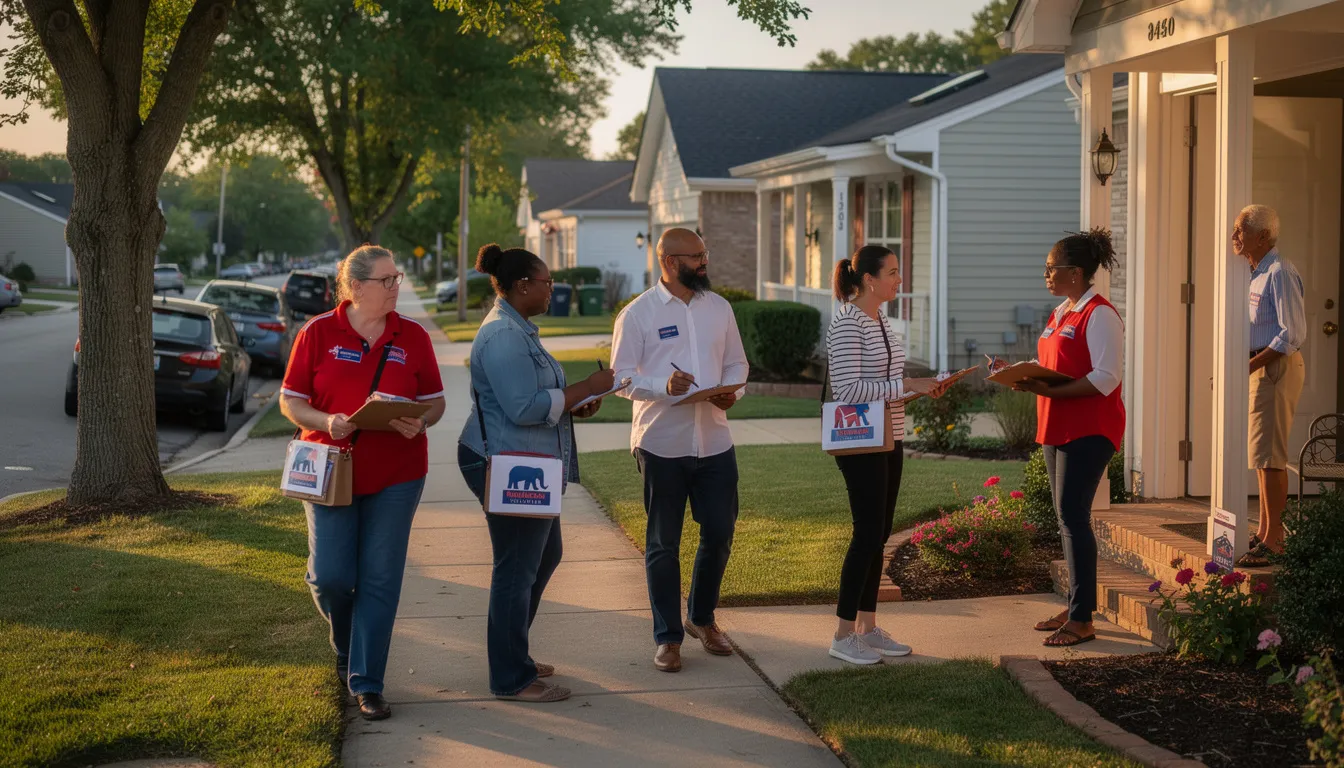
Votes are won through direct contact. Door-to-door canvassing, phone calls, SMS outreach, and community meetings remain the highest-impact activities in any campaign, especially in close races decided by hundreds or low thousands of votes.
Research consistently shows that personal touch matters: door-to-door canvassing generates 70–80% recall rates compared to 10–15% for most paid media.
Build Your Field Plan
Your voter contact programs should segment voters based on your voter file:
Segment | Definition | Contact Priority |
Strong supporters | Voted for your party 3+ times, high propensity | GOTV focus |
Leaners | Mixed voting history, some party alignment | Persuasion + ID |
Persuadable | Independents, split-ticket voters | Heavy persuasion |
Unlikely supporters | Consistent opposition voters | Low/no contact |
Use data collection from 2016–2024 elections to model these segments before your first canvass.
Use a Voter Contact Platform – Pulsar
Modern political campaigns can’t operate effectively without campaign software—specifically, a robust voter contact platform. The right platform enables campaigns to build targeted walk lists, run efficient phone banks, and deploy compliant text messaging at scale. Just as important, it centralizes voter interactions so every door knock, call, and text can be tracked, measured, and refined over time. A voter contact platform like Pulsar by Campaign Sidekick brings these capabilities together in one system, helping campaigns focus resources on the voters most likely to decide the outcome of the race.

For additional information regarding Pulsar please visit Pulsar.Vote or send an email to team@campaignsidekick.vote.
Canvassing Operations
Design walk lists by precinct, prioritizing high-propensity persuadable voters. Train canvassers on:
Script delivery (memorized, not read)
Listening for key issues
Recording support levels accurately
Handling hostile interactions gracefully
Set weekly door-knocking goals: a competitive state legislative race might target 500–1,000 doors per week during persuasion phase, increasing to 2,000+ during GOTV.
Phone Banking and Texting
For making phone calls at scale:
Use predictive dialers for high-volume voter ID calls
Deploy volunteer phone banks for persuasion (more conversational)
Employ peer-to-peer texting for event mobilization and GOTV reminders
Ensure TCPA compliance: obtain consent before texting, honor opt-outs immediately, and maintain records.
Relational Organizing
Empower volunteers to reach their own networks—friends, coworkers, congregation members, campus organizations. This approach works exceptionally well for:
Young voters skeptical of traditional political outreach
Communities of color with strong social networks
Rural areas where neighbors trust neighbors
Use a voter contact platform to track these interactions.
Coalition and Community Engagement
Meet regularly with:
Neighborhood associations and homeowner groups
Faith leaders and congregations
Labor locals and professional associations
Business groups and chambers of commerce
Student groups and campus organizations
Tailor your talking points to each group’s specific concerns. A housing message for renters differs from one for homeowners.
Create a Feedback Loop
Field data should inform everything:
Which issues resonate in which precincts?
Where are you finding other voters who remain undecided?
Which neighborhoods need more candidate time?
Where should you shift resource allocation for final weeks?
Your field operation isn’t just about reaching potential voters—it’s your best source of real-time intelligence about the race.
Leverage Digital, Media, and Programmatic Advertising
In the digital era, online advertising has become central to any successful campaign. U.S. digital political ad spend grew over 150% between the 2016 and 2024 cycles, exceeding billions of dollars in the 2024 presidential race alone. Even local elections now require a digital strategy.
Build Core Digital Assets
Every campaign needs:
Professional campaign website with clear donation and volunteer funnels, mobile-optimized
Active email list built from day one through sign-ups, events, and voter contact
Social media accounts on relevant platforms (Facebook, Instagram, YouTube, X, TikTok where appropriate for your target audience)
Content calendar planning posts, videos, and ads 2–4 weeks ahead
Programmatic Advertising
Programmatic ads use automated buying to reach specific audiences across display, video, and connected TV (CTV). In the 2024 cycle, many campaigns used CTV to reach cord-cutters in suburban and younger households—voters who never see traditional television ads.
Targeting Tactics
Tactic | Application |
Geotargeting | Serve ads only to voters in your district/precinct |
Lookalike audiences | Reach people similar to your donors and supporters |
Contextual placements | Ads on news sites and issue-relevant content |
Retargeting | Re-engage visitors to your campaign website |
Speed and Optimization
Digital marketing offers speed that traditional media can’t match:
Launch ads within days of an event or opponent attack
Review performance metrics in real time
A/B test creatives, messages, and audiences
Shift spend rapidly to high-performing segments
This agility is especially valuable in primary elections with fast-moving dynamics.
Integrate Digital with Field and Mail
Ensure consistent branding across all channels. Use digital to:
Cross-promote fundraising events and town halls
Drive volunteer sign-ups to feed field operations
Time persuasion ad waves with absentee ballots and early vote windows
Reinforce mail messages with matching digital creative
Earned Media and Press Relations
Build relationships with local reporters covering your race. A story in the local paper or TV news segment reaches voters more credibly than paid media.
Draft press releases for campaign announcements, endorsements, policy rollouts
Prepare thoroughly for political debates and candidate forums
Use earned media to complement paid digital and broadcast buys

GOTV: Closing Strong in the Final Two Weeks
Get out the vote is the phase starting roughly 10–14 days before election day when your campaign shifts almost entirely from persuasion to turning identified supporters into actual votes. No amount of brilliant messaging matters if your supporters don’t cast ballots.
Finalize Your GOTV Universe
Pull your voter database to create a list of:
Strong supporters (ID’d through canvassing and phone banking)
Strong leaners (favorable responses but not fully committed)
Persuaded voters from your persuasion phase
Focus on voters who have voted in some past elections but are not perfect voters—the “sometimes voters” who might skip your race without a reminder.
GOTV Tactics
Tactic | Timing | Focus |
Tightly scripted canvassing | Days 14–1 | Voting logistics only |
Intensive phone banking | Days 10–1 | Reminder calls, vote plan |
Peer-to-peer texting | Days 7–1 | Personal reminders |
Mail ballot chase | Days 14–1 | People who requested but haven’t returned absentee ballots |
Early Voting and Absentee Ballots
Where early vote is available:
Encourage supporters to vote early (reduces election day uncertainty)
Track who has already voted using updated voter files
Shift resources away from voters who’ve already cast ballots
Intensify contact with those who still need to vote
Election Day Operations
Prepare:
Staging locations for volunteers with supplies, food, and transportation
Ride-to-the-polls programs for elderly, disabled, or transit-dependent voters
Legal and voter protection hotlines for issues at polling locations
Poll observers where permitted by law
Real-time turnout monitoring by precinct to redirect resources
Message Discipline During GOTV
Avoid policy arguments during the final 72 hours. Don’t waste time relitigating political debates. Focus instead on:
Social accountability (“Your neighbors are voting—join them”)
Civic duty (“This is your chance to make your voice heard”)
Concrete voting plans (“Where will you vote? What time? Do you have ID?”)
Care for Your Team
The final weekend and election day itself are exhausting. Maintain morale by:
Scheduling shifts to prevent burnout
Providing food, coffee, and transportation
Celebrating small wins (precinct turnout goals met)
Thanking volunteers constantly and sincerely
People power wins elections, and your volunteers are giving you everything they have.
After the Election: Win, Lose, or Rebuild
How you handle the weeks after election day shapes your long-term influence and future campaigns, regardless of whether you win or lose. Many campaigns treat election night as the end—but it’s really the beginning of your next chapter.
If You Win
Your campaign work transforms into transition planning:
Begin building staff for your elected role
Honor campaign promises in your first 100 days
Maintain contact with volunteers and donors (they’re your future re-election army)
Thank supporters publicly and personally
If You Lose
Defeat rarely ends a political career. Many successful elected officials lost their first race. Your next steps:
Conduct a post-mortem: Analyze data by precinct, review fundraising reports, assess what worked and failed
Preserve relationships: Your volunteers, donors, and endorsers may return for a future run
Stay visible: Continue attending community meetings and local events
Professional Conduct
Whether winning or losing:
Concede promptly and graciously when appropriate
Thank supporters, campaign staffers, and volunteers publicly
Never blame volunteers or specific communities for the outcome
Maintain relationships with other candidates, even opponents
Convert Experience to Influence
Campaign experience opens doors to:
Legislative staff positions
Advocacy organizations and issue campaigns
Party leadership roles
Future campaigns in the next election cycle
Build for the Long Term
Keep your email list warm with occasional updates. Stay active at community events. The lessons from this cycle—what messages resonated, which precincts surprised you, where you found other voters who might support future candidates—inform a stronger effort in 2026 and beyond.
Conclusion
Winning a political campaign is the product of early planning, disciplined message and brand, professional team structure, strong fundraising, relentless voter contact, and a rigorous get out the vote operation. There are no shortcuts, and there are no last-minute miracles. The work starts 12–18 months before election day and intensifies until the final ballot is cast.
Authenticity and long-term community relationships are decisive. Voters reward candidates who show up consistently—at town halls, community meetings, and on their doorsteps—not just in the last 60 days of a campaign trail sprint. The candidates who knock doors in February, who remember names from the last event, who follow up after every meaningful conversation, are the ones who build lasting impact.
Adapt these principles to your own electoral context: local elections in 2025, state races in 2026, or national and referendum campaigns beyond. No two races are identical, but the fundamentals remain constant. Treat this plan as a living document you refine each cycle as new data, tools, and lessons emerge. Start campaigning with clarity, execute with discipline, and never forget that every single person you talk to could be the vote that puts you over the top.
FAQ
How far in advance should I start my campaign to have a realistic chance of winning?
For competitive races, begin serious planning 12–18 months before election day. Use the first 3–6 months for research, message development, and early fundraising, then build full field and media operations in the final 9–12 months. For small local races with very low turnout, 6–9 months can work if you already have strong name recognition and community roots in your target audience.
Can a mostly volunteer campaign actually beat a well-funded opponent?
Yes, in many local and some state legislative contests, a disciplined volunteer operation can overcome a cash disadvantage. The keys are strong field organizing (especially door-to-door), a clear contrast message, and tight voter targeting of high-impact precincts. However, volunteers must be well trained, coordinated, and supported with clear talking points and scripts. A loose, uncoordinated volunteer effort rarely defeats a truly professional operation.
How important are national issues compared to local issues in winning a campaign?
In most campaigns below the national level, local concerns—taxes, schools, public safety, housing, infrastructure—are more decisive than abstract national debates. Connect national themes to concrete local impacts (how federal infrastructure or education policy affects your specific town’s roads or schools) but keep the focus on what you can actually change in your elected role. Voters want to know how you’ll make their daily lives better.
What is the single most common mistake first-time candidates make?
Many new candidates underestimate the time needed for fundraising and direct voter contact. They spend too much time on branding details (logos, slogans, merchandise) and too little on call time and field work. Block daily hours for fundraising calls and weekly targets for voter conversations, starting as soon as you announce. The right voters don’t care about your logo—they care whether you’ve asked for their vote.
Do I need sophisticated data analytics to win, or can I rely on basic voter lists?
Advanced modeling is helpful in close, high-budget races, but many successful campaigns rely on well-maintained voter files, consistent data entry from canvassing and phone calls, and simple segmentation (supporter vs undecided vs opposed; frequent vs infrequent voter). Focus first on accurate data collection and regular analysis of precinct-level results. Add more sophisticated analytics only as resources allow and after you’ve mastered the basics.