Key Takeaways
- Modern political targeting focuses on voters most likely to decide an election outcome, especially in swing states and competitive congressional districts where margins can be razor-thin.
- Campaigns use voter files, consumer data, social media behavior, and past turnout records to identify “persuadable” voters and “sometimes-voting” supporters who could tip the scales.
- Targeting happens across multiple channels: door-to-door contact, phone and text outreach, direct mail, digital ads, TV placement, and email—all coordinated around common voter universes.
- Effective targeting must balance legality, ethics, transparency, and data protection while avoiding unconstitutional weaponization of government resources against political opponents.
- The difference between winning and losing often comes down to who gets the right message to the right voters at the right time.
What Is Political Targeting in Political Campaigns?
Political targeting is the practice of focusing campaign resources on specific voters who are most likely to determine whether a campaign wins or loses. Rather than broadcasting the same message to everyone, modern political campaigns analyze the electorate and narrow their focus to the individuals whose behavior will decide the outcome.
The distinction between broad messaging and targeted outreach is significant. A national TV ad during prime time reaches millions of viewers—many of whom live in safe states or have already made up their minds. A tailored Facebook ad reaching suburban undecided voters in Pennsylvania or a door-knock in a swing precinct in Maricopa County represents a fundamentally different approach: precision over volume.
Political targeting has both positive uses and negative perceptions. On the positive side, it can mobilize likely supporters who might otherwise skip an election, inform infrequent voters about issues that matter to them, and help campaigns allocate limited resources where they’ll have the greatest impact. On the negative side, critics raise concerns about voter manipulation, privacy violations, and the potential for campaigns—or worse, government actors—to use targeting infrastructure for harassment or selective punishment of opponents.
Consider recent elections where campaigns concentrated enormous resources on key battleground states like Wisconsin, Arizona, and Georgia because these states had
Core Targets: Voters Who Decide Elections
Not all voters are equally important for winning. Campaigns must prioritize those whose behavior can realistically change the election result, which means focusing resources where marginal effort produces marginal votes.
Persuadable Voters
These are voters whose partisan or candidate preference isn’t firmly locked in. They might be weak partisans, independents, or cross-pressured voters who lean conservative on one issue but liberal on another.
Concrete examples include:
- Suburban independents in Maricopa County, Arizona, who split their tickets between 2018 and 2022
- College-educated women in Philadelphia suburbs who voted Republican in 2014 but Democratic in 2018
- Working-class voters in Wisconsin who supported Obama in 2012 but Trump in 2016
Campaigns develop “persuasion scores” to estimate how likely each voter is to change their preference, then concentrate communications on those with high persuadability in competitive geographic areas.
Low-Propensity Supporters
These are registered partisans who agree with your policies but have inconsistent voting histories. They might vote in presidential years but skip midterms, or they might be young voters who registered but haven’t yet developed the habit of casting ballots.
Examples include:
- Democratic-leaning voters who skipped the 2014 and 2022 midterms but turned out in 2020
- Republican-leaning rural voters who vote in presidential years but miss local elections
- Young voters aged 18-29 who registered during a presidential campaign but have never voted in an off-year
Mobilizing these voters can be decisive, especially in lower-turnout elections where activating your base matters more than persuading the middle.
Swing Congressional Districts and Geographic Areas
At the geographic level, campaigns heavily prioritize jurisdictions where vote margins are historically narrow:
| Region | Key States/Areas | Why They Matter |
| Blue Wall | Pennsylvania, Michigan, Wisconsin | Decided 2016 and 2020 presidential outcomes |
| Sun Belt | Georgia, Arizona, Nevada | Increasingly competitive, growing diverse populations |
| House Districts | Suburban districts in CA, TX, NY, FL | Determine congressional majorities |
| High-turnout, strongly partisan voters in safe states—whether deep-blue California or deep-red Oklahoma—often receive less marginal campaign attention. They rarely flip outcomes, so resources spent there have lower returns than resources spent in battlegrounds. |
Data Foundations of Political Targeting
Modern targeting is built on detailed voter and consumer data that campaigns and parties have assembled since the early 2000s and refined each election cycle. This infrastructure has transformed political campaigns from guesswork into political science.
The Voter File
Every state maintains voter registration records that are available to campaigns, parties, and vendors. A typical voter file includes:
- Name, address, date of birth, and gender
- Party registration (in states where voters register by party)
- Voting history from 2010–2026—which elections the person voted in, but not who they voted for
- Phone numbers and email addresses (where available)
These records form the foundation of all targeting. A voter who has cast ballots in the last five general elections looks very different from someone who last voted in 2012.
Commercial Data Enhancement
Parties and data vendors append commercial information to enrich voter profiles:
- Magazine subscriptions and purchasing patterns
- Home value and homeownership status
- Modeled income and education levels
- Charitable giving patterns
- Proxies for religious attendance and community involvement
These data points can signal issue priorities or cultural identity. A household that subscribes to hunting magazines, owns firearms, and donates to conservation groups likely has different concerns than one that subscribes to environmental publications and donates to climate organizations.
Voter Scores
Using polling, surveys, and prior campaign data, campaigns develop predictive models that estimate for each voter:
| Score Type | What It Measures | How It’s Used |
| Turnout Score | Likelihood of voting (0-100) | Prioritize GOTV contacts |
| Support Score | Probability of supporting your candidate | Identify base vs. opponents |
| Persuasion Score | Responsiveness to persuasive messaging | Target swing voters |
| Issue Scores | Salience of specific issues | Tailor message content |
| The 2008 Obama campaign pioneered many of these techniques, and by 2012, 2016, and 2020, both parties had sophisticated modeling operations that helped prioritize which doors to knock and which calls to make. |
Legal and Regulatory Boundaries
Targeting operates within a framework of rules:
- State public records laws govern access to voter files
- FEC rules require disclosure of ad spending and coordination limits
- Platform policies shape what’s possible on Facebook, Google, and others
- Google and Twitter implemented restrictions on political microtargeting starting in 2019-2020
These rules continue to evolve as legislators and platforms respond to concerns about privacy and electoral integrity.
Voter Contact: Field Operations and Direct Outreach
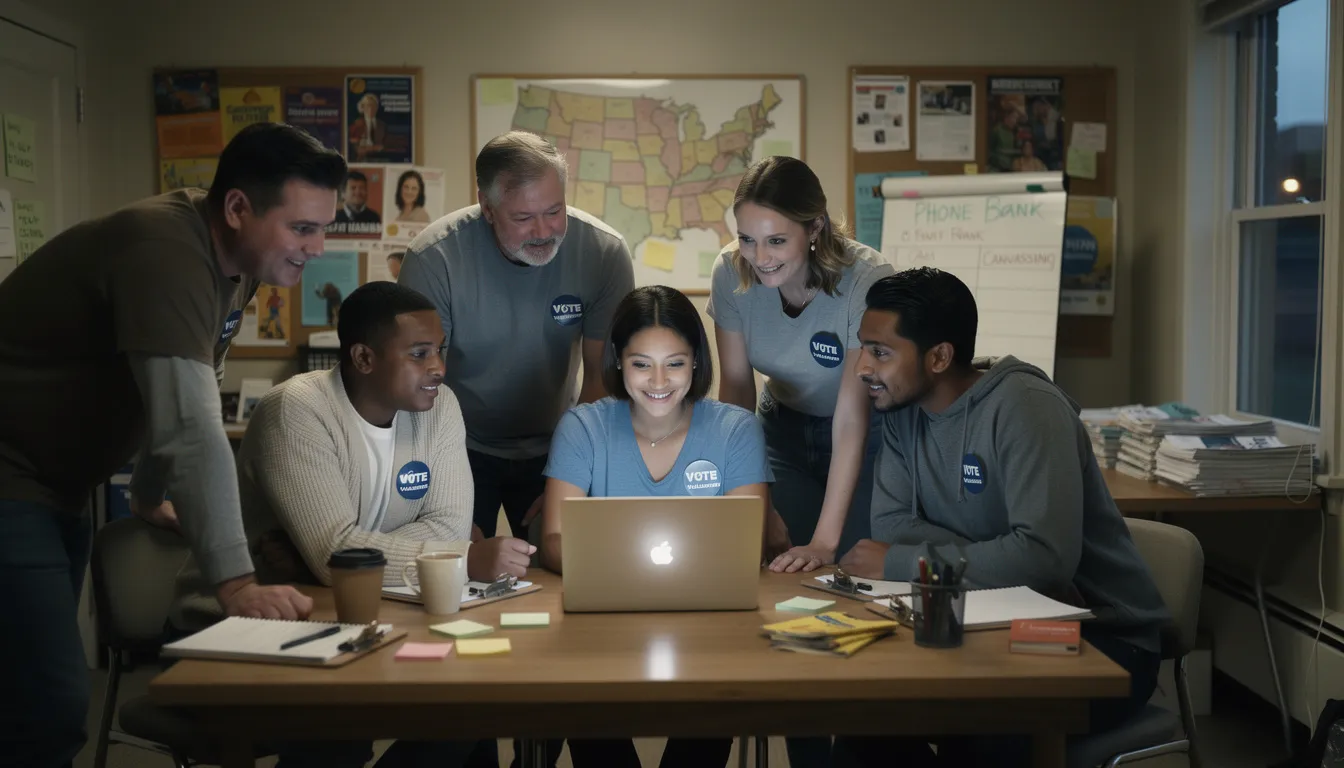
The field program is where data becomes real conversations—door knocks, phone calls, and texts to precisely chosen voters. This is where targeting moves from spreadsheets to front porches.
Door-to-Door Canvassing
Modern canvassing looks nothing like wandering randomly through neighborhoods. Campaigns generate “walk lists” from voter scores and cut turf to focus on high-impact precincts.
A well-targeted door-knocking operation might focus on:
- Milwaukee wards with high concentrations of persuadable voters
- Atlanta suburbs where turnout among Democratic-leaning voters lagged in 2022
- Specific blocks in Phoenix where voters have high support scores but low turnout propensity
Canvassers carry tablets or phones with scripts customized by targeting segment. Canvass results—support level, issues mentioned, updated contact info—feed back into the database to refine models and lists for future contacts.
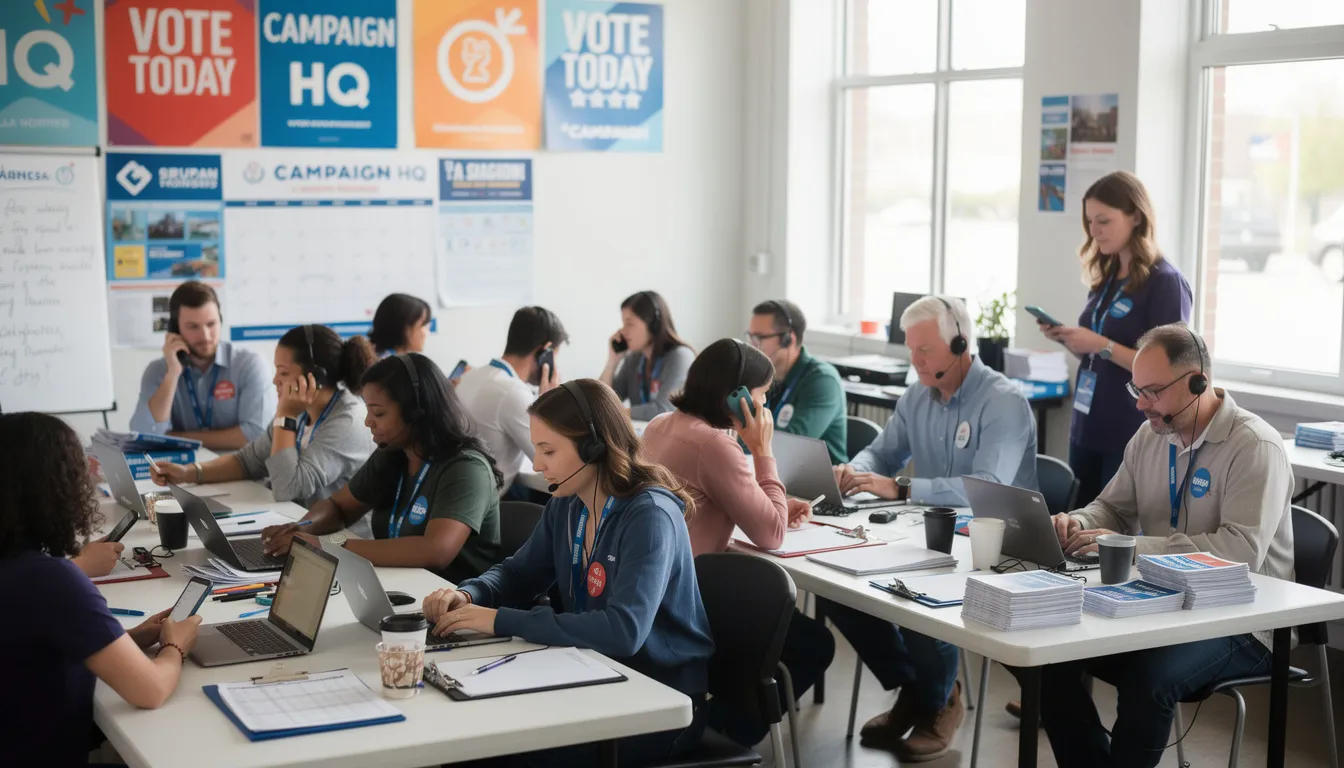
Phone Banking and Peer-to-Peer Texting
Phone outreach uses targeting to prioritize calls to crucial universes:
- Uncontacted persuadables who haven’t responded to other outreach
- Supporters needing a GOTV reminder as Election Day approaches
- Voters who request absentee ballots but haven’t returned them
SMS campaigns can reach targeted lists with messages about relevant issues, local events, early voting information, or election reminders. A parent of young children might receive messages about child care funds or education policy, while a recent graduate might see content about student loans or job markets.
Direct Mail
Mail targeting is highly data-driven. Campaigns create mail universes based on turnout, support, demographics, and issue models:
- One piece might go to homeowners with high property-tax concerns in suburban swing areas
- Another might target older base voters focused on Social Security or the Medicaid program
- Issue-specific mailers on healthcare, food benefits, or lowering costs can reach voters modeled as caring most about those topics
Mail remains important for reaching older and less-online voters, rural areas with limited broadband, or any group shown by behavioral models to be receptive to printed material.
Timing and Human Contact
The most intensive voter contact happens in the final weeks before Election Day. Weekend GOTV pushes before November 5, 2024, saw campaigns deploying thousands of volunteers to knock doors and make calls in target precincts. Human contact serves as a multiplier of data-driven lists—a conversation with a neighbor or community member carries more weight than an anonymous ad.

Voter Contact Software
Given the complexity of modern political targeting, campaigns inevitably face a practical question: How do we actually turn this data into voter conversations that win elections? That’s where voter contact software becomes essential. Modern campaigns cannot rely on spreadsheets, paper lists, or disconnected tools. Voter contact software transforms raw voter data into actionable outreach—allowing campaigns to precisely target voters and contact them through door-to-door canvassing, phone calls, and text messaging, all from a centralized platform.
At its core, voter contact software bridges the gap between strategy and execution. Instead of guessing which doors to knock or which voters to call, campaigns can generate targeted lists based on turnout history, support and persuasion scores, geography, and issue priorities. Field staff and volunteers see exactly who to contact, what message to deliver, and how to record the result. Every interaction—whether it’s a doorstep conversation or a completed call—feeds back into the system, continuously improving targeting and ensuring campaigns focus their time where it matters most.
Pulsar is built specifically for this modern, data-driven approach to voter contact. The platform brings together voter targeting, walk lists, phone banking, and peer-to-peer texting into a single, intuitive interface designed for real-world campaign operations. Campaigns can quickly create voter universes, assign turf, and deploy volunteers without weeks of training or expensive technical staff. Whether you’re running a local race or a large-scale statewide operation, Pulsar helps campaigns move faster, stay organized, and execute with precision.
Beyond basic outreach, Pulsar emphasizes clarity, accountability, and ease of use—critical advantages in fast-moving campaigns. Campaign managers can monitor progress in real time, identify gaps in coverage, and adapt strategy as new data comes in. Volunteers spend less time wrestling with tools and more time talking to voters. The result is a more disciplined field program: fewer wasted contacts, better messaging alignment, and a higher likelihood that the right voters hear from your campaign at the right moment.

Digital and Social Media Targeting
Social platforms like Facebook, Instagram, YouTube, and TikTok enable campaigns to serve tailored messages to key voter segments at relatively low cost compared to traditional media. Digital targeting has become central to how political campaigns reach voters where they spend their time.
High-profile figures, such as the president, often use a truth social post reacting to ongoing investigations or political disputes. These posts can then be amplified through targeted digital campaigns to reach specific audiences.
Audience Building Basics
Campaigns build audiences for digital ads through several methods:
Method | Description | Best Used For |
Custom Audiences | Upload email lists or voter file segments | Reaching known supporters or targets |
Lookalike Audiences | Platform finds similar users to your best donors/supporters | Expanding reach to persuadable voters |
Geographic Targeting | Target specific ZIP codes, counties, or states | Focusing on battleground areas |
Interest/Behavioral Targeting | Reach users based on page likes, content engagement | Issue-based messaging |
A campaign might upload a list of 50,000 high-propensity supporters from their voter file, create a custom audience on Facebook, then build a lookalike audience to find similar voters in battleground states. |
Research on Effectiveness
Studies from the 2020s, including research from MIT and other institutions, show that targeting based on a single attribute like party ID can boost support among the targeted group. However, adding many attributes—trying to micro-segment down to dozens of characteristics—often has diminishing returns. The most effective targeting tends to be relatively simple: reach the right people with a relevant message.
Concrete Examples in Practice
Real-world digital targeting might include:
- Ads about conservative values served to suburban voters in key swing areas
- Messages supporting small businesses and economic growth reaching owners in Las Vegas and Phoenix
- Ads highlighting the importance of protecting taxpayer dollars and combatting fraud nationwide targeted to fiscally conservative swing voters
- Messages about lowering costs and supporting food benefits programs to voters modeled as caring most about those topics
Platform Rules and Transparency
Since 2018-2026, major platforms have implemented significant changes:
- Ad transparency libraries that let anyone see what political ads are running
- Limits on detailed microtargeting (e.g., Facebook restricting targeting by race, religion, or political affiliation)
- Requirements for clear disclaimers about who paid for the ad
- Some platforms, like Twitter/X, have at various points banned political ads entirely
Campaigns must navigate these evolving rules while finding ways to reach their target audiences.
Paid Media, Traditional Advertising, and Message Testing
Campaigns integrate TV, radio, and streaming ads with digital targeting to saturate decisive voters—not the entire country. The goal is reaching the voters who matter most, not maximizing raw impressions.
DMA Targeting for Television
Designated Market Areas (DMAs) determine how TV ad buys are structured. Smart campaigns buy heavily in markets that cover swing voters while avoiding expensive markets in safe states.
DMA | State Coverage | Why It Matters |
Detroit | Michigan | Covers key Wayne County suburbs |
Phoenix | Arizona | Reaches Maricopa County persuadables |
Atlanta | Georgia | Accesses fast-growing diverse suburbs |
Philadelphia | Pennsylvania | Hits crucial collar counties |
Milwaukee | Wisconsin | Covers swing precincts statewide |
Buying ads in New York or Los Angeles might reach millions, but few of those viewers are in competitive races. Efficient campaigns concentrate spending where it can change outcomes. |
Connected TV and Programmatic Advertising
Connected TV (CTV) allows more granular audience-based buys. Campaigns can target households based on:
- Modeled turnout and support scores matched to addresses
- Demographics and geography
- Viewing habits on streaming platforms
This is especially important for reaching cord-cutters and younger or more affluent audiences who don’t watch traditional broadcast television. A campaign might serve ads during NFL games or presidential debates specifically to households in swing precincts—something impossible with traditional TV buying.
Message Testing and Optimization
Before scaling a message, campaigns test extensively:
- A/B testing online: Run different ad creatives to small samples and measure engagement
- Controlled experiments: Test persuasive messages on small groups of persuadable voters and measure attitude change
- Dial testing: Traditional focus group method where participants react in real-time to video content
The winning messages then scale for broader distribution. Testing typically happens 6-9 months before Election Day, with persuasion flights in summer and heavy GOTV ads in the final two weeks of October and early November.

Ethical, Legal, and Democratic Concerns
It’s important to distinguish legitimate campaign targeting from the abusive weaponization of state power against political opponents. One is democracy in action; the other is democratic erosion. Some critics argue that certain political strategies cross ethical lines by exploiting vulnerable groups or spreading misinformation to manipulate public opinion.
Privacy, Data Protection, and Safeguarding Taxpayer Dollars
Political microtargeting depends on collecting, combining, and analyzing large quantities of personal data, often without voters’ explicit awareness. Concerns include:
- Voters don’t know what’s been inferred about them from their digital behavior
- Sensitive attributes like religion, health status, or immigration background might be modeled and used
- Data shared with campaigns might be breached, sold, or misused
The collection of data about voters’ preferences, behaviors, and vulnerabilities raises questions about consent and control. When campaigns know more about voters than voters know about themselves, the power dynamic shifts.
Transparency and Dark Ads
Since 2016, there’s been intense debate over “dark ads”—political messages visible only to targeted recipients and invisible to journalists, fact-checkers, or opponents. This opacity complicates accountability.
Responses have included:
- Platform ad archives that let anyone view running political ads
- Requirements for “paid for by” disclaimers
- Proposed legislation requiring disclosure of ad targeting criteria
Republican officials and democratic governors alike have raised concerns about the lack of transparency in political advertising, though they often disagree about solutions.
Designing a Targeting Strategy for a Modern Campaign to Improve Government Efficiency
This section provides a practical blueprint for campaigns, from city council races to presidential contests. The fundamentals apply across scale, even if resources differ dramatically.
Step 1: Define Your Win Number
Before targeting anyone, calculate how many votes you need to win:
- Analyze prior turnout in your jurisdiction
- Add margin for expected changes in electorate composition
- Account for population growth or decline
- Consider whether it’s a high-turnout presidential year or low-turnout off-year
Your win number drives everything else. If you need 52,000 votes to win and there are 40,000 reliable base voters in your universe, you need to find 12,000 more through persuasion or mobilization.
Step 2: Identify Decisive Geographies
Not all precincts matter equally. Focus on:
- Competitive precincts where margins have been close in recent cycles
- Precincts with high concentrations of persuadable or low-propensity voters
- Growing areas where new registrants haven’t yet established voting patterns
- Areas with demographic shifts that might change past patterns
A former elections clerk or local party official can often help identify which neighborhoods are truly in play versus locked in.
Step 3: Build Data Infrastructure
Even small campaigns need basic data systems:
Campaign Size | Minimum Data Needs |
Local (school board, city council) | Voter file with turnout history, basic contact info |
Legislative (state house, state senate) | Enhanced voter file with party scores, phone/email, door-knock tracking |
Congressional | Full data stack with support models, digital tracking, CRM integration |
Statewide/Presidential | Unified data warehouse, real-time modeling, cross-channel attribution |
Invest in data infrastructure early. Campaigns that wait until September to build their voter universe are already behind. |
Step 4: Segment Voters into Target Groups
Divide your universe into actionable segments:
- Core base: High-support, high-turnout voters (maintain, don’t invest heavily)
- Mobilization targets: High-support, low-turnout voters (GOTV priority)
- Persuasion targets: Moderate-support, any-turnout voters (persuasion messaging)
- Opponent base: Low-support, any-turnout voters (ignore or discourage if legal/ethical)
Your campaign plan should specify how many contacts each segment receives and through which channels.
Step 5: Align Budget with Segments
Resources should flow to where they’ll have the greatest impact:
- Assign field teams to high-impact doors, not random neighborhoods
- Reserve digital ads for hard-to-reach demographics like young voters or cord-cutters
- Time mail and SMS for early voting windows when voters are making decisions
- Concentrate TV buys in markets that cover your target precincts
Campaigns often waste money on broad reach when precision would serve them better.
Step 6: Measure and Adjust Continuously
Track what’s working:
- Contact rates (doors knocked, calls completed, emails opened)
- Response data (support levels recorded, persuasion success)
- Turnout among contacted vs. non-contacted targets
- Experimental results comparing different messages or channels
Run experiments to refine who is truly persuadable versus firmly decided, then shift resources accordingly. A voter modeled as persuadable who consistently expresses opposition should be moved off your contact list.

Frequently Asked Questions
How can small campaigns with limited budgets use political targeting without expensive data?
Even local school board or city council campaigns can access basic voter files through their state or county at minimal cost. Focus on turnout history—voters who participated in similar past elections are your best targets. Use free tools like Google Sheets to track contacts, and rely on volunteers who know the community to identify persuadable neighbors. The core principle—focus resources where they’ll matter—applies regardless of budget.
Does political targeting actually change minds, or does it mostly mobilize people who already agree?
Research suggests both effects are real, but mobilization is often more reliable. Persuading a true undecided voter is difficult and effects are typically modest per contact. Mobilizing a likely supporter who might otherwise skip the election has clearer returns. That said, in very close races, even small persuasion effects aggregated across thousands of contacts can be decisive. The most effective strategies combine both.
How can voters see what data campaigns have about them, and can they opt out?
Voter registration records are public in most states, so you can request your own record from your county elections office. Commercial data is harder to access—you’d need to contact individual data brokers. Some states have data privacy laws letting residents request and delete their information. To reduce your footprint, limit social media sharing, opt out of data broker lists, and be cautious about surveys or petitions that collect personal information.
What ethical lines should campaigns never cross when building target lists?
Campaigns should avoid: exploiting highly sensitive health or financial information that could harm voters if exposed; targeting messages designed to suppress turnout rather than persuade; using data obtained through deception or illegal means; and creating messages that mislead voters about voting procedures, dates, or locations. Transparency about who is sending messages and why is essential. Targeting should inform and mobilize voters, not manipulate or disenfranchise them.
Is political targeting different at the presidential level versus down-ballot races?
The fundamentals are the same, but scale and sophistication differ enormously. Presidential campaigns have budgets exceeding half a trillion dollars across cycles and sophisticated modeling teams. A state legislative race might have a few thousand dollars and rely on volunteer door-knocks. But both campaigns must answer the same core question: which voters can we move, and how do we reach them efficiently? Down-ballot campaigns often benefit from “riding the wave” of presidential-level organizing in their area.