What Is Phone Banking in Politics? A Modern Guide for Campaigns
Key Takeaways
Political phone banking is the organized practice of campaign volunteers and staff making direct calls to voters to identify supporters, persuade undecided voters, raise funds, and mobilize turnout on Election Day. Despite widespread spam fatigue, phone banking remains one of the most effective voter contact methods because it creates genuine, two-way conversations that digital ads and mass emails simply cannot replicate.
- Phone banking enables campaigns to reach nearly every potential voter in a district, with 97% of American adults owning a cell phone.
- Modern phone banking relies on integrated software platforms like Pulsar’s voter contact tools—not paper lists and spreadsheets—to manage call lists, scripts, and data collection in real time.
- Campaigns typically run multiple types of phone banks throughout an election cycle: voter identification, persuasion, Get Out The Vote (GOTV), fundraising, and volunteer recruitment.
- Well-executed phone banking programs produce structured voter data that feeds into targeting, polling, and message testing across all campaign outreach efforts.
- This guide covers the history of political phone banking, types of phone banks, technology, best practices, legal considerations, and how Pulsar fits into a campaign’s overall outreach strategy.
What Is Phone Banking in Politics?
Political phone banking is the practice of organized, campaign-run calling to registered voters and supporters during election cycles. Unlike commercial telemarketing, which targets random numbers for sales, phone banking uses carefully curated voter files to contact specific individuals based on their voting history, party affiliation, and geographic location.
Campaigns use phone banking to accomplish several core objectives:
- Voter ID: Identifying who supports your candidate, who opposes, and who remains undecided
- Persuasion: Convincing undecided voters to support your candidate or cause
- Fundraising: Soliciting donations from past donors and strong supporters
- Volunteer recruitment: Recruiting volunteers for canvassing, phone shifts, and events
- Get Out The Vote (GOTV): Reminding confirmed supporters to vote and confirming their plans
Phone banking functions as a form of “remote canvassing,” achieving similar goals as door to door canvassing but delivered over the phone. This makes it particularly valuable for reaching voters who aren’t home during traditional canvassing hours or who live in areas that are difficult to canvas on foot.
With roughly 97% of American adults owning cell phones or mobile phones, a well-targeted phone banking campaign can reach nearly every potential voter in a district. The key difference from commercial telemarketing is that political campaigns work from voter files obtained from state election offices or data vendors, targeting specific universes of voters rather than dialing randomly.
A Brief History of Political Phone Banking
Political phone banking emerged as a key tactic in the 1960s, coinciding with the rise of grassroots organizing during pivotal U.S. movements like civil rights and anti-war efforts. In those early days, volunteers gathered in union halls and campaign offices, working through paper call sheets with rotary phones and marking responses with tally marks on clipboards.
Throughout the 1990s and early 2000s, campaigns continued to depend heavily on manual processes. Campaign staff would print voter lists from the local election office, distribute pages to volunteers, and spend hours after each phone bank session on manual data entry to consolidate results. This approach worked for local races but created significant bottlenecks for larger campaigns.
The 2000s brought centralized voter databases and the first generation of political CRMs. Platforms like VAN standardized scripts, tracking, and reporting, allowing campaigns to see results in near real-time rather than waiting for data to be compiled manually. This shift transformed phone banking from an art into a measurable science.
The Obama 2008 and 2012 presidential election campaigns popularized large-scale, volunteer-driven phone banks and pioneered early online distributed calling tools. For the first time, supporters across the country could make campaign calls from their homes, dramatically expanding the pool of available volunteers beyond those who could physically travel to a campaign office.
COVID-19 in 2020 accelerated this shift dramatically. With in-person canvassing suddenly unsafe, campaigns nationwide pivoted to virtual phone and text outreach. What had been an emerging trend became standard practice overnight, normalizing at-home phone banking and proving that distributed calling operations could match or exceed the effectiveness of traditional phone banks.
Today’s phone banking is fully data-driven and software-enabled. Modern political campaigns integrate phone banking tightly with their field, digital, and data teams, using platforms like Pulsar to coordinate voter contact across channels and track every interaction in a unified political CRM.
Why Campaigns Still Use Phone Banking
Despite the rise of social media, digital ads, and peer to peer texting, campaigns continue investing heavily in phone banking programs. The reason is simple: phone calls create personal, two-way conversations that most broadcast channels cannot replicate.
When a volunteer calls a voter, they can listen to concerns, answer questions in real time, and adapt their message based on the conversation. This personal touch builds trust in ways that a mailer or Facebook ad simply cannot. Phone banking is particularly effective with older, high-propensity voters who may be less engaged with digital channels and with supporters who need a direct ask to commit to voting.
Campaigns also use phone banking to test messages and collect real-time feedback. When volunteers hear the same objection repeatedly, that intelligence flows back to campaign managers and helps refine messaging across all channels. Phone calls reveal local issues, concerns about other candidates, and questions about ballot measures that polling alone might miss.
Well-run phone programs are measurable. Campaigns track connection rates, ID rates, persuasion rates, and ultimately compare turnout among contacted voters versus those who were not reached. This data collection allows campaign managers to calculate return on investment and make informed decisions about resource allocation.
Phone banking works best when coordinated with texting, canvassing, and email—not as a standalone tactic.
The most effective voter outreach strategies layer multiple contact methods, using phone calls to follow up on text messages, confirm canvass results, and reinforce digital advertising.
Types of Political Phone Banking
Not all phone banks serve the same purpose. Each type has a distinct goal, script structure, and targeting strategy based on where the campaign falls in the election cycle.
Most political campaigns will run several types of phone banks in sequence as Election Day approaches. Early in the campaign, the focus is on identifying supporters. As the race heats up, persuasion becomes the priority. In the final weeks, everything shifts to turnout.
A political CRM and voter contact platform like Pulsar lets campaigns configure different call universes, scripts, and survey questions for each type of phone bank, ensuring that every conversation serves the campaign’s current goals.
Voter Identification (Voter ID) Phone Banking
Voter ID calling typically begins several months before Election Day. The goal is straightforward: figure out who supports your candidate, who is undecided, and who opposes.
Common questions in a voter ID script include:
- Which candidate do you plan to support in the upcoming election?
- What issues matter most to you this year?
- How do you prefer to be contacted by the campaign?
Callers code responses directly in the phone banking software using standardized scales (e.g., Support-1, Lean-2, Undecided-3, Oppose-4). These results build the universes used for later persuasion and GOTV efforts.
For example, a city council campaign in 2026 might call 6,000 voters over two months and identify 2,000 strong supporters who later become the core of their GOTV universe. Without this foundational ID work, campaigns are essentially flying blind about where their votes will come from.
Persuasion Phone Banking
Persuasion calls target undecided voters or those weakly aligned with either side. These voters are typically identified through polling, modeled data, or earlier voter ID calls.
Persuasion scripts focus on issues rather than simply asking for support. They might highlight the candidate’s position on education, public safety, or economic development while drawing contrast with the opponent. Scripts are often tailored for specific demographics—a message about school funding might resonate differently with parents than with retirees.
Persuasion calling is usually heaviest in the middle of the campaign, after initial ID work establishes who needs convincing but before the final GOTV push. Platforms like Pulsar can use modeled data to assign more relevant talking points, ensuring volunteers have personalized messages for different voter segments.
Get Out The Vote (GOTV) Phone Banking
GOTV calls are the final push. They typically start 7-10 days before Election Day and intensify during early voting and on Election Day itself.
The goal of GOTV is not persuasion—that work should already be done. Instead, GOTV calls focus on turnout: confirming voting plans, sharing polling locations, reminding voters of vote-by-mail deadlines, and arranging transportation if needed.
Campaigns prioritize high-support, medium-propensity voters for GOTV calls. These are people likely to back the candidate but who may forget to vote without a reminder. The campaign’s win number depends on converting these supporters into actual votes.
A GOTV script is short, direct, and focused on a concrete commitment:
“Hi, this is [name] calling from the [candidate] campaign. Can we count on you to vote on Tuesday, November 5th? Do you know where your polling place is?”
Fundraising Phone Banking
Campaigns use fundraising phone banks to solicit donations, especially from past donors and identified strong supporters. This includes both call time (where the candidate personally makes calls) and volunteer fundraising phone banks.
Fundraising calls require more training than voter ID or GOTV calls. Volunteers must understand contribution limits, know how to record pledges accurately, and follow clear compliance guidance for financial reporting.
A state legislative campaign might call 500 past donors over one week to raise funds for late TV and digital ads. The key is having a clear ask amount and making it easy for donors to contribute—whether by credit card over the phone, a follow up text with a donation link, or a mailed check.
Integrated platforms allow instant logging of donation pledges, amounts, and follow-up actions so the finance team can track progress toward fundraising goals in real time.
Volunteer Recruitment and Event Phone Banking
Campaigns run dedicated phone banks to recruit canvassers, poll watchers, and event attendees. These calls are especially important before major weekends of action when the campaign needs to maximize door-knocking capacity.
Recruitment scripts emphasize specific roles, dates, and shift times. They capture information about volunteers’ skills, availability, and preferences. A strong recruitment call converts a passive supporter into an active participant in the campaign.
Phone banking for recruiting volunteers can quickly fill gaps in door-knocking or texting crews when the campaign is behind on its field plan. If Saturday canvassing shifts are only 60% full by Wednesday, a quick recruitment phone bank can close that gap.
Pulsar’s volunteer management tools can automatically add interested supporters from calls into volunteer shift lists, eliminating the manual work of transferring sign-ups between systems.
How Political Phone Banking Works in Practice
A successful phone banking campaign follows a consistent workflow: planning, setup, calling, data entry, and follow-up. Each step builds on the last, creating a system that becomes more effective over time.
The political CRM and voter contact system serves as the central hub for this entire process. Platforms like Pulsar store voter data, manage scripts, assign calls to available volunteers, and generate reports—all in one place.
Building and Targeting Your Call List
Every phone banking campaign starts with a voter file. Campaigns obtain these lists from state election offices, political party organizations, or data vendors, then upload or sync them into their voter contact platform.
Once the voter file is loaded, campaign managers filter it based on specific criteria:
Filter Type | Examples |
Geography | District, precinct, zip code |
Voting history | Voted in 2020 and 2022, missed 2022 primary |
Party registration | Democrats, Republicans, Independents |
Demographics | Age range, gender |
Modeled scores | Likelihood to support, turnout propensity |
For a November 2026 GOTV phone bank, a campaign might define a “likely supporter, low-propensity” universe: voters who have been identified as supporters but who don’t vote in every election. These are the voters most likely to be swayed by a reminder call.
Good list hygiene improves connection rates dramatically. This means removing bad phone numbers, deceased voters, and do-not-call flags before launching calls. Pulsar’s preloaded voter files help campaigns skip much of this cleanup work.
Designing Scripts and Survey Questions
Scripts should be concise, conversational, and tailored to the specific phone bank type. A voter ID script asks different questions than a GOTV script, and persuasion scripts need more flexibility than either.
Key elements of an effective script include:
- Introduction: Who you are and what campaign you represent
- Reason for the call: Why you’re reaching out today
- Main content: 1-3 key points or questions
- Call to action: What you’re asking the voter to do or confirm
Survey questions are entered directly into the phone banking software during or after the call. This eliminates manual data entry and ensures that voter data flows immediately into the campaign CRM.
Sample script structure for a local school board campaign:
“Hi, is this [voter name]? My name is [volunteer name] and I’m calling on behalf of [candidate] for School Board. We’re reaching out to voters to understand what education issues matter most to you. Do you have a moment to share your thoughts on our local schools?”
Recruiting and Training Volunteers
Experienced volunteers are the backbone of any phone banking operation, but every campaign also needs to bring in new volunteers throughout the election cycle.
Volunteer recruitment channels include:
- Campaign email lists and supporter databases
- Social media posts and targeted ads
- Local political party organizations
- In-person events and community gatherings
- Referrals from existing volunteers
Training is essential, especially for potential volunteers who have never made campaign calls before. Best practices include:
- 15-30 minute orientation covering the campaign’s goals and message
- Script walkthrough with explanation of each section
- Role-playing to practice handling different voter responses
- Clear instructions on logging data in the phone banking tools
- Code of conduct covering respect, patience, and handling hostile calls
Virtual phone banks typically begin with a short video call to onboard volunteers and end with a debrief and feedback session. This structure ensures volunteers feel supported and can ask questions in real time.
Running In-Person vs Virtual Phone Banks
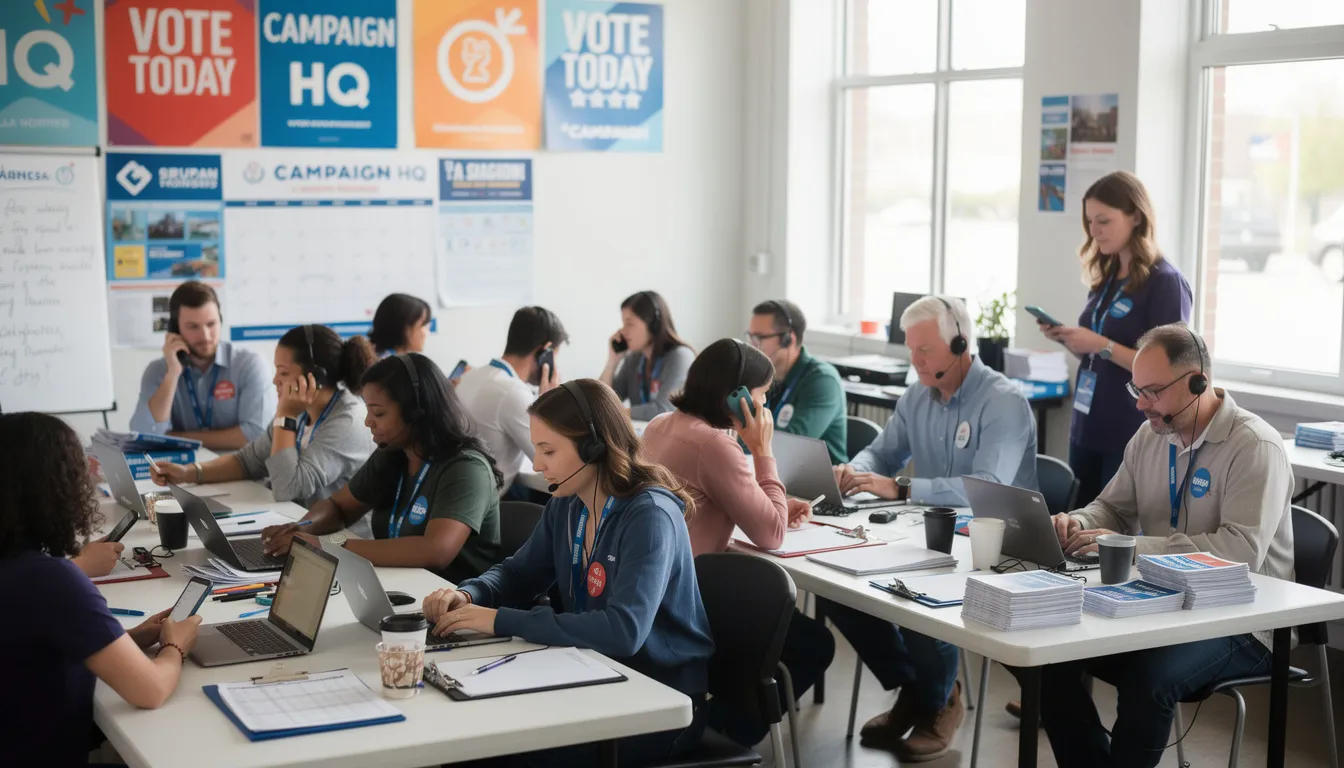
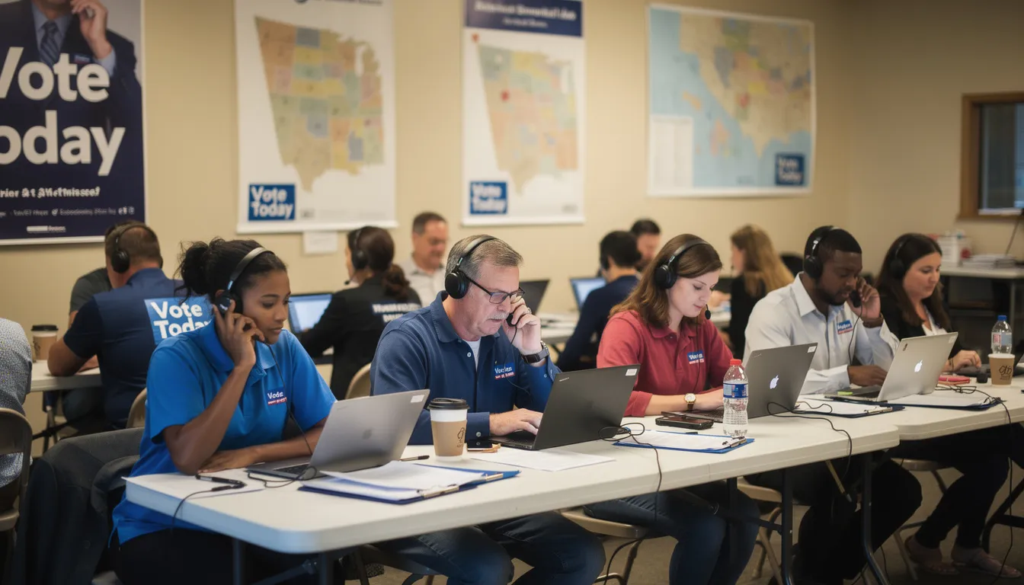
Traditional in-person phone banks bring everyone together in a campaign office, union hall, or supporter’s living room. Volunteers work side by side, and staff can provide immediate support when questions arise.
Virtual phone banking, where volunteers call from home using their own cell phones and the campaign’s software, has exploded in popularity since 2020. Each approach has distinct advantages:
In-Person Phone Banks | Virtual Phone Banks |
Stronger community and energy | Greater flexibility for volunteers |
Easier immediate support | Can recruit volunteers statewide |
Better oversight and quality control | No venue or travel logistics |
Builds volunteer relationships | Scales without physical constraints |
Modern distributed organizing often combines both approaches: anchor events at campaign headquarters with ongoing at-home calling shifts throughout the week. Pulsar supports both setups by letting volunteers log in from any browser and auto-assigning voters from shared call lists.
Recording Data and Following Up
Capturing accurate data is as important as making the next call. Every phone conversation should result in a logged outcome: supporter, undecided, oppose, wrong number, do not call, or no answer.
Entries in the phone banking system automatically update each voter’s profile in the campaign’s CRM. This creates a continuous feedback loop:
- Support IDs feed into persuasion and GOTV universes
- Volunteer interest flags sync to the volunteer team
- Donor pledge amounts sync to finance workflows
- Issue concerns inform messaging across channels
For example, a voter identified as a supporter in June gets added to the GOTV call list for October. When that call happens, the volunteer can reference the earlier conversation and add a volunteer recruitment ask based on the voter’s profile.
Technology Behind Modern Phone Banking
The days of paper lists and manual tally sheets are largely over for serious campaigns. Even down-ballot races now rely on integrated platforms that combine voter files, dialers, texting, canvassing, and reporting in one system.

Pulsar is an example of this type of political campaign platform, designed specifically for voter contact and field operations. Understanding the technology options helps campaign managers choose the right tools for their race.
Dialer Options: Manual, Preview, and Predictive
Manual dialing is exactly what it sounds like: volunteers physically dial each number, often using their personal cell phones. This approach is common when calling mobile phones, as some regulations restrict automated dialing to cell phone numbers. Manual dialing allows for the deepest conversations (8-15 minutes) but limits the number of calls per hour.
Preview or click-to-call dialers show the voter’s information on screen, then place the call with one click. This balances speed and personalization—volunteers can review voter data before the call connects but don’t waste time manually dialing numbers. The dialing process becomes semi-automated while preserving the personal connection.
Predictive dialing uses algorithms to dial multiple numbers simultaneously, connecting only answered calls to available volunteers. Predictive dialers can boost efficiency dramatically, enabling 20-40 calls per hour compared to 10-20 with manual dialing. However, they’re subject to stricter regulations and work best with high-quality voter lists.
Campaigns choose dialer modes based on legal constraints, target lists, and volunteer experience level. Pulsar supports different workflows to accommodate varying campaign needs.
Political CRM and Voter File Integration
A political CRM stores each voter’s contact details, voting history, support level, and every interaction across channels—phone, text, canvass, email. This unified view ensures that every campaign touchpoint builds on previous contacts.
Preloaded voter files in Pulsar save campaigns from manually importing data from multiple sources. Instead of spending days cleaning and uploading data from the local election office and various data vendors, campaigns can start calling immediately with accurate, up-to-date voter information.
Phone banking tools should sync call results instantly back to the central CRM. When a volunteer logs a new supporter, the field team sees that update immediately, and the digital team can add that voter to email segments. This eliminates duplicate records, enables cleaner targeting, and simplifies reporting for consultants, state parties, and candidate staff.
Data, Modeling, and Reporting
Modern campaigns use modeled data to prioritize who gets called first and what messages to use. Models predict turnout likelihood, issue affinity, and candidate support based on demographic and behavioral factors.
Robust phone banking software provides dashboards summarizing:
- Total calls made and attempts
- Connection rates by time of day and day of week
- IDs collected and support rates
- Progress toward the campaign’s win number
A weekly field report might show that phone banking identified 350 supporters, canvassing found 200, and peer to peer texting confirmed 150—giving campaign managers a complete picture of voter contact across channels.
Pulsar’s analytics help campaign managers quickly adjust call universes, scripts, and volunteer deployment based on what’s performing best. If evening calls are connecting at twice the rate of afternoon calls, the data makes that clear.
How Pulsar Supports Phone Banking Campaigns
Pulsar includes preloaded voter files, a political CRM, and integrated phone banking, texting, canvassing, and polling tools in one system. This integration eliminates the need to juggle multiple platforms or manually sync data between systems.
Campaigns can set up targeted lists by state, district, or precinct, assign them to volunteers, and log responses in real time. Scripts and survey questions are fully customizable, and results flow directly into voter profiles for future outreach efforts.
More than 120,000 campaigns have used Pulsar to run voter contact operations, from city council races to U.S. Presidential campaigns. The platform offers race-level plans sized appropriately for different campaign scales, with straightforward pricing and quick onboarding.
Benefits and Challenges of Phone Banking in Today’s Environment
Phone banking remains one of the most powerful tools in campaign outreach, but it’s not without challenges. Understanding both sides helps campaigns set realistic expectations and develop strategies to maximize effectiveness.
Key Advantages of Political Phone Banking
Personal conversation at scale: Unlike mass media, phone banking creates one-on-one interactions where callers can listen, adapt, and build genuine connections with voters directly.
Geographic flexibility: Volunteers can call voters across an entire state or multiple states in a single evening. A supporter in Ohio can make calls for a race in Arizona without leaving home.
Relatively low cost: For volunteer-driven programs, the primary costs are software and staff time for coordination. This makes phone banking accessible even for campaigns with limited budgets.
Adaptability: Phone banking can pivot quickly from persuasion to GOTV or from voter ID to volunteer recruitment as campaign needs change in the final weeks.
Structured data production: Every call generates data that feeds into polling, modeling, message testing, and future outreach efforts.
Common Challenges and How to Address Them
Low answer rates: Robocall fatigue and spam blocking mean many voters simply don’t answer calls from unknown numbers. Average answer rates range from 20-40%, meaning campaigns must plan for large call volumes.
Mitigations: Use local caller IDs where possible. Train volunteers to clearly identify the campaign immediately when voters answer. Keep scripts concise and respectful of voters’ time.
Mobile phone regulations: Auto-dialing cell phones is subject to restrictions under federal and state law, pushing many campaigns toward manual or preview dialing.
Mitigations: Choose appropriate dialer modes based on your target list. Platforms like Pulsar help campaigns stay compliant with calling rules.
Voter skepticism: Some voters are skeptical of any campaign contact, viewing it as intrusive or disingenuous.
Mitigations: Train volunteers to be conversational rather than robotic. Focus scripts on listening and addressing concerns, not just delivering talking points.
Volunteer burnout: Repeatedly calling unresponsive voters can wear down even motivated volunteers.
Mitigations: Keep phone shifts short (2 hours maximum). Gamify progress with leaderboards and goals. Celebrate milestones like reaching contact targets.
Integrated platforms like Pulsar help manage opt-outs, DNC flags, and calling rules to reduce legal and reputational risk while keeping the dialing process efficient.
Legal, Ethical, and Best Practice Considerations
Political phone banking must be conducted responsibly, respecting both legal requirements and voter privacy. While political calls enjoy certain exemptions from telemarketing regulations, campaigns still face rules that vary by state and calling method.
Compliance and Calling Rules
U.S. campaigns must be aware of federal rules like the Telephone Consumer Protection Act (TCPA) and state-specific regulations governing robocalls and automated dialing.
Key compliance considerations:
- Many jurisdictions restrict auto-dialers to landlines and require consent before auto-dialing cell phones
- Manual or click-to-call workflows are generally safer for mobile phone lists
- Campaigns must accurately identify themselves in caller ID displays
- Federal elections require specific FEC compliance for party phone banks
Maintain internal do-not-call lists and promptly honor voter requests to stop receiving campaign calls. Phone banking software should automatically flag numbers as DNC and prevent future calls to those records.
Always consult legal counsel for up-to-date guidance specific to your state and race type.
Respecting Voters and Building Trust
Ethical phone banking goes beyond legal compliance. It’s about building long-term trust with the general public, even voters who disagree with your candidate.
Best practices include:
- Always introduce yourself and the campaign clearly
- Be honest about the purpose of the call
- Allow space for voters to share concerns rather than delivering one-directional talking points
- Avoid calling at inappropriate hours (before 9 AM or after 9 PM)
- Respect “no” and don’t argue with voters who decline to engage
- Know when to escalate specific questions to staff rather than guessing
Respectful, well-run phone banks can leave a positive impression even on voters who ultimately disagree. Encouraging people to vote—regardless of who they support—builds goodwill that benefits democracy as a whole.
Getting Started: Setting Up Phone Banking with Pulsar
If you’re ready to launch or upgrade your phone banking program, the path forward is straightforward: define goals, choose target universes, select technology, recruit volunteers, and start calling.
Pulsar offers race-level plans for campaigns from city council to presidential races, with preloaded voter files that speed up onboarding. Instead of spending weeks on data preparation, campaigns can start making calls within days of signing up.
Step-by-Step Launch Checklist
- Clarify objectives: Determine whether your immediate goal is voter ID, persuasion, GOTV, fundraising, or volunteer recruitment
- Choose call universes: Filter your voter file based on geography, voting history, party affiliation, and modeled scores
- Set scripts and surveys: Draft concise, conversational scripts with clear survey questions that capture the data you need
- Configure phone banking in Pulsar: Upload or sync your call lists, assign scripts, and set up survey response options
- Recruit and train volunteers: Bring in potential volunteers through email, social media, and local party organizations; run training sessions before the first shift
- Run a pilot phone shift: Start with a small group of ensure volunteers understand the system before scaling up
- Review metrics: After the first few shifts, analyze connection rates, ID results, and volunteer feedback
- Scale: Expand the number of calls, volunteers, and calling hours based on what’s working
Recommended timelines:
- Start Voter ID phone banking 3-6 months before Election Day in competitive races
- Shift to persuasion 2-3 months out
- GOTV calling intensifies in the final 2 weeks
Even small campaigns can start with modest phone banks—5-10 volunteers for a few hours—and grow as they recruit more people. Pulsar’s interface allows quick script edits and dynamic assignment of call lists as campaign goals evolve.
Ready to see how Pulsar can support your campaign? Schedule a demo or request a quote for your specific race.

FAQ
How many volunteers do I need to run an effective political phone bank?
The number depends on your race size, voter universe, and campaign goals. For a small city council district, 5-10 consistent volunteers making calls a few hours per week can be sufficient. Statewide or congressional races may need 50+ volunteers working regular shifts. An average volunteer might have 10-20 live conversations per hour with well-organized lists and technology. Pulsar’s reporting helps you back-calculate how many shifts you need to hit your contact targets before Election Day.
How do I know if my phone banking is actually working?
Track key metrics: attempts, answered calls, IDs collected, support rates, and commitments to vote. Over time, campaigns can compare turnout and support among contacted voters versus non-contacted voters to estimate impact. Research suggests volunteer phone banks can increase turnout by 5-10% among contacted supporters. Integrated analytics in platforms like Pulsar make it easy to see which lists, messages, and calling times perform best, letting you adjust strategy in real time.
Is phone banking better than texting or door-knocking?
Each channel has strengths. Door-knocking creates the deepest personal connections but is limited by geography and volunteer capacity. Texting through text messages is fast and scalable, especially for younger voters, but offers shallower engagement. Phone banking falls in between—more personal than texting, more scalable than canvassing. The most effective campaigns use all three in coordination: canvassing where possible, phone banking to reach voters who aren’t home, and texting for quick follow ups and reminders.
Can small, local campaigns benefit from phone banking software?
Absolutely. Even school board, city council, or county-level campaigns benefit from structured call lists, scripts, and data tracking. Software reduces the need for manual data entry, keeps every voter interaction in one place, and helps small teams punch above their weight. Pulsar offers plans sized for local races, with preloaded local voter files and simple tools designed for volunteer-driven programs. You don’t need a massive budget to run a successful phone banking campaign.
When should I start phone banking for an upcoming election?
For competitive races, start Voter ID calls 3-6 months before Election Day. This gives you time to build a robust supporter universe. Persuasion calling typically runs through the middle months of the campaign. GOTV phone banking intensifies in the final 1-2 weeks, focusing on confirmed supporters who need a turnout reminder. Special elections or low-turnout contests may require a compressed timeline, but even a few weeks of calling provides valuable voter data. Map your phonebanking efforts to your overall field plan and adjust based on early metrics from your program.